
Monday, 5 September 2016

How is Honda BR-V different from Honda Mobilio?


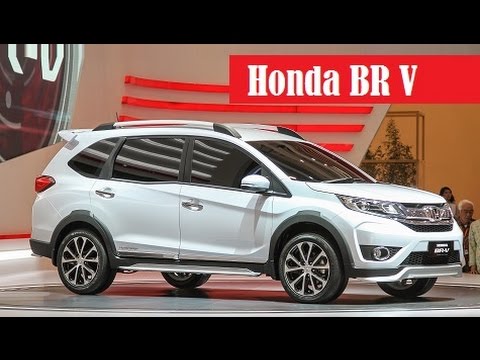
Honda has been one of the MOST RELIABLE automobile manufacturer till now and it is the same even now. It had recently launched an affordable MPV called the "Mobilio", but it did not click as well as Honda thought it would. Honda did not lose hope and it again launched the crossover called the "Honda BR-V", which is also a seven seater but has SUV kind of looks and is competing with the likes of the Hyundai Creta. Now let us get to know what are the differences between the Honda Mobilio and the Honda BR-V.

Honda BR-V vs Honda Mobilio - Comparison

Honda is planning to gatecrash the Hyundai Creta‘s party with its rendition of the small SUV, a category that is easily one of the most popular in India right now. The car in question is the BR-V, yet another product derived from the Brio‘s platform. Honda scrapped its initial plans of bringing the HR-V to India citing high production costs and decided to develop an all-new product instead. The BR-V shares a lot of common features with existing Honda products in order to keep costs in check. Although the SUV is costing a bit more than the Mobilio MPV, there is still a price overlap, which could lead to a slight bit of cannibalism within the ranks of Honda. We take a look at exactly what sets the BR-V and Mobilio apart and how they compare with each other in our Honda BR-V vs Honda Mobilio spec sheet comparison. 


Honda BR-V vs Honda Mobilio Price 

Comparison 


Currently, the petrol Mobilio retails for INR 7.10 lacs – INR 10.60 lacs while the diesel costs INR 8.60 lacs- 12.25 lacs. The BR-V costs around two lakhs more retailing in the INR 8.75-13 lac region. For the extra money, all you get is increased ground clearance, better looks, and more features. 

ModelHonda BR-VHonda Mobilio
Petrol
EINR 8.99 LakhsINR 7.10 Lakhs
SINR 9.40 LakhsINR 8.19 Lakhs
VINR 11.29 LakhsINR 9.49 lacs
V (O)INR 10.06 lakhs
VXINR 11.84 lakhs
V CVTINR 11.99 Lakhs
Diesel
EINR 10.40 LakhsINR 8.60 Lakhs
SINR 11.10 LakhsINR 9.36 Lakhs
VINR 12.20 LakhsINR 10.55 Lakhs
V (O)INR 11.12 Lakhs
VXINR 12.90 Lakhs
The BR-V commands a significant premium over the Mobilio, which is a little hard to justify considering all you really get is a slightly better exterior and probably a couple more features. 

Honda BR-V vs Honda Mobilio 

Specification comparison


Honda BR-VHonda Mobilio
Length x Width x Height4456x1735x1666 mm4386x1683x1603 mm
Kerb Weight1199 kg1246 kg
Wheel Type and Size16-inch alloys15-inch alloys
Boot Space223 litres223 litres
Engine Type/ Displacement1.5 L Petrol/1.5 L diesel1.5 L Petrol/1.5 L diesel
Power119 bhp/98.6 bhp118 bhp/99 bhp
Torque145 Nm/200 Nm145 Nm/200 Nm
Transmission (Gearbox)5-speed MT/6-speed MT/CVT5-speed MT/5-speed MT
Mileage16 kpl/21.9 kpl17.3 kpl/24.2 kpl


The BR-V borrows the Mobilio’s engines without much change in specifications. Additionally, Honda is offering the small SUV with a CVT borrowed from the Honda City, but only in the petrol guise. The diesel motor comes with a 6-speed manual and the petrol gets a 6-speed manual as well. 

There isn’t a significant difference in terms of specifications as both models are powered by the same engines. Which means, the diesel Honda BR-V is the least powerful amongst its direct competitors like the Hyundai Creta and Renault Duster. Also, it will be a little disadvantaged by the lack of a diesel automatic variant. The specifications of the Honda BR-V do little justice to the price premium one will have to pay for the SUV over the Mobilio.

Design

The Honda BR-V features a new, aggressive front end complete with projector headlamps, LED pilot lamps and black cladding. Adding to the SUV appeal are roof rails, beefier tyres, and faux skid plates at the front and the back. The taillamp design is interesting as the units are connected via a thin strip running through the boot. In side profile, both cars are almost identical featuring the same, slightly unconventional window line and a very large glass house. It also gets an increased ride height, and new front and rear bumpers.
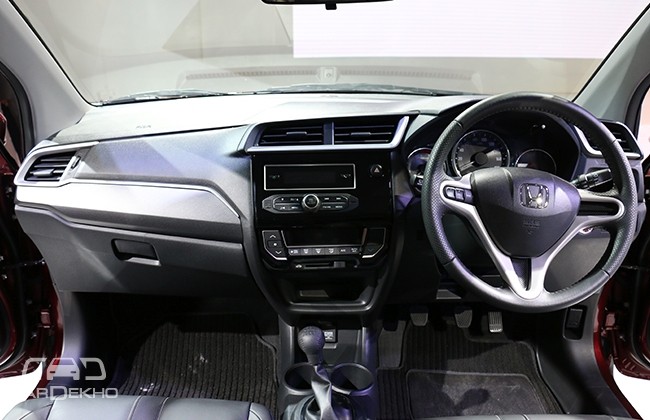

On the inside, Honda has, thankfully, ditched the Brio’s spartan, low rent interiors for a more premium design that is reminiscent of the Honda Jazz and identical to what we have seen in the recently launched Amaze facelift. Both cars offer seven seats and almost the same amount of interior space. However, the Mobilio facelift that will be launched this year will get the same interiors as the BR-V. Therefore, essentially, both models will have the exact same cabin.


Features

In comparison to the Mobilio, the BR-V gets some extra equipment. This includes automatic climate control, push-button start, standard dual front airbags and more. Other additions include leather upholstery and a leather-wrapped steering wheel and gear knob. LED tail lamps, projector headlamps, and LED DRLs are also being offered, at least on the top spec trims. However, some significant omissions include a touchscreen AVN, parking sensors, and reverse parking camera.

Honda BR-V does not get a touchscreen AVN

Honda Mobilio vs Honda BR-V Expert 

Verdict


Both cars are powered by the same set of engines, offer seven seats and are underpinned by the same platform. The Honda BR-V looks and feels more upmarket than the Mobilio. Then there is the SUV appeal and the added advantage of an optional automatic transmission. However, following the price announcement made by Honda, the BR-V does not make a very strong case for itself, but could still end up poaching Mobilio’s customers.
Design – The BR-V is definitely the better looking of the two with its beefy styling, SUV-ish styling, and improved interiors. However, both models possess that unmistakable MPV silhouette.
Features – Honda offers the BR-V with more features than the Mobilio. However, the facelifted Mobilio, when launched, could get the additional features as well.
Specifications – Apart from the optional CVT, everything else is shared by the two Honda products. The BR-V is be powered by the same 1.5-litre diesel from Honda known for its high NVH and low refinement levels.
Price – The BR-V sits in the 9-13 lacs price bracket making it considerably more expensive than the Mobilio MPV.


We hope our Honda BR-V vs Honda Mobilio comparison helped you in figuring out which of these two makes more sense. 

Stay tuned to http://abhinavsomisetty.blogspot.in for more updates. 



Tuesday, 12 January 2016

Top Ten Most Expensive Cars in the world!


1. Koenigsegg CCXR Trevita ($4.8M)


Koenigsegg makes its youthful appearance in the list with the CCXR Trevita, and it does so as the most expensive street-legal production car in the world. Why so much noise? With no exaggeration, the car is literally coated in diamonds … and diamonds aren’t cheap.
For the Trevita, the Swedish manufacturer developed a new exterior finish called the Koenigsegg Proprietary Diamond Weave, which involves coating carbon fibers with a diamond dust-impregnated resin. We can’t even guess how much the touch up paint costs.

Underneath the lustrous finish lies a 4.8-liter, dual-supercharged V8 with a total output of 1,004 hp and 797 lb-ft, which means it should have little to no trouble overtaking high speed cars on the freeway.

2. Lamborghini Veneno ($4.5M)


Poison – it is the name chosen for the modified Aventador and was built to celebrate the automaker’s 50th birthday. The company’s motivations cannot be spoken about, but the name is fit for a vehicle that looks deadly and undeniably venomous.
The car is absolutely stunning from every angle, and to this day, we’re not convinced it isn’t an alien spacecraft surveying our planet for eventual takeover. It just doesn’t seem real. The only thing more remarkable than the look is the price — a whopping $4.5 million.
The Veneno is fast, and that should come as no surprise. Its 6.5-liter V12 spins all the way up to 8,400 rpm to deliver 740 hp and 507 lb-ft, surging the car to 60 mph in 2.9 seconds.

3. W Motors Lykan Hypersport


Do you remember this Lykan Hypersport in Furious 7, where it crashed through skyscrapers, testament to its magnetism!

Let’s start with the styling, which includes jewel-encrusted headlights, scissor doors, and an interior ripped straight from science fiction. It looks like a pissed off armored car from the future, and its performance is right on par with its image. The Hypersport boasts a 3.7-liter, twin-turbo flat-six that yields 770 hp and 708 lb-ft.

It’s not just Dominic Toretto who benefits from this level of performance though, as the Abu Dhabi police force has drafted the Hypersport into patrol duty. Although it’s mainly used for marketing and public relations purposes, the high-flying stunner assures that the authorities can keep up with any baddie that tries to get cute on the freeway. Pedal to the floor, 0 to 62 mph is accomplished in just 2.8 seconds, and top speed is a downright scary 240 mph.

4. Mansory Vivere Bugatti Veyron ($3.4M)


This list wouldn’t be complete without some version of the mighty Bugatti Veyron. The spotlight is on the Mansory Vivere edition here, because not only is it one of the fastest cars in the world, it’s one of the most expensive.

Augmented by German witch doctors Mansory, the 1,200-hp Veyron starts out as a Grand Sport Vitesse Roadster, only to be adorned with a gorgeous carbon fiber body, a new spoiler package,    upgraded LED lights, a rebuffed cabin, and a redesigned front grill. Further classifying the Veyron as a work of art, maps of historic race events like the Targa Florio are laser etched into the exterior and interior. It can touch 254 mph.

5. Ferrari F60 America ($2.5M)


To celebrate Ferrari’s 60-year tenure in North America, the Italian brand built 10 examples of this stunning bombshell. Based on the F12 Berlinetta, the F60 is undeniably US patriotic as it wears a Stars and Stripes color scheme, American flag seat inserts, and classic racing livery all around. Better yet, you can experience the glory with the top down, as the F60 equips a lightweight fabric top that can be operated at speeds up to 75 mph. Its 6.2-liter V12 churns out 740 glorious hp, enough to propel the car to 60 mph in only 3.1 seconds.

6. Koenigsegg One:1 ($2.0M)


You can buy a lot with $2 million — a really nice house, about 80 Mazda MX-5’s, or the Swedish “megacar” shown above. A logical thinker could probably think of a better way to spend your life savings, but megacars don’t give a damn about logic. Because they’re mega. And after reading what the car is capable of, $2 million might actually be a steal.

The limited-edition One:1 is based on the Agera R, and it earned its poetic nickname by employing a 1:1 kilogram-to-horsepower ratio. The figure on each side of the colon? 1,340. That’s right, this car has 1,340 hp, and can theoretically top 273 mph because of it. Simply put, this is one of the fastest automobiles ever made, and with its F1-style honeycomb core, carbon fiber intake manifold, and ventilated ceramic brakes, it’s one of the most advanced as well. Just six of these were built and each one was sold quite quickly.

7. Aston Martin One-77 ($1.4M)


1.4 million sure is a popular number in the supercar world, because that’s what it took to get your hands on this limited-edition Aston. We say “took” because all 77 units have been spoken for, so if you were hoping to channel your inner Bond with this car, your luck has unfortunately run out.

The One-77 which is the  most classically handsome car on this list was built around a carbon fibre monocoque chassis,  with a handcrafted aluminum body to give it a sophisticated, aggressive look.

Under the vented hood lurks a naturally aspirated V12 that displaces 7.3 liters, which is a lot. It produces 750 hp and 553 lb-ft, which is also a lot. The One-77 is the fastest Aston Martin ever because it reaches 220 mph in the right conditions. From a stop, it can do 0 to 60 in just 3.5 seconds.

8. Pagani Huayra ($1.4M)


The Huayra is equally as famous for its odd-sounding name as it is for its face-melting performance. Named after the Incan God of Winds, the Huayra boasts an AMG-sourced 6.0-liter V12 with two turbochargers, resulting in 620 hp and a massive 740 lb-ft.

Around the Top Gear test track, it set a time of 1:13.8, some 3.0 seconds quicker than the Bugatti Veyron Super Sport. It even bested the Ariel Atom 500, which is essentially a go-kart. It still holds the show’s track record to this day, and that’s just the beginning. With incredible gullwing doors and one of the most intricate interiors ever designed, the Huayra is like nothing else on the road.

9. Ferrari LaFerrari ($1.4M)


This 950-hp hypercar is so prestigious that its name literally translates to “The Ferrari” in Italian. The automaker’s first mild hybrid, LaFerrari equips a 6.3-liter V12 alongside an electric motor and trick Kinetic Energy Recovery System, which results in a shade less than 1,000 ponies and 664 pavement-crushing torques.

Few cars on the road are more striking, and even fewer accelerate faster. With a dry weight of less than 2,800 pounds, this dragon-like performance car accelerates from 0 to 60 mph in less than 3.0 seconds, and it’ll prance to 124 mph in under 7. Flat out, it’ll top 217 mph.

The only thing quicker than the car itself is how fast it sold, as all 499 units were snatched up faster than you can say “bank loan.” Ferrari also produced a hardcore, FXX K version specifically for the track, which we’ll delve into later.

10. Zenvo ST1 ($1.2M)


Kicking off our list is less of a car and more of an unchained animal in the ST1. Assembled in Zealand, Denmark, the Zenvo creates an absolutely obscene amount of power by combining a 6.8-liter V8 with both a supercharger and a turbocharger. Just how much is obscene exactly? How about 1,104 horsepower and 1,054 pound-feet of torque, all channeled to the car’s rear wheels.

Unfortunately for the Danish outfit, the mostly hand-built ST1 has been surrounded with controversy since its debut. During Top Gear’s 21st season, the program tested the supercar around its famous track, only to be met with constant breakdowns, slower than expected lap times, and a good old-fashioned engine fire.

Zenvo disputed Top Gear’s claims, stating the show only published the vehicle’s sluggish laps and that the fire was caused by hours of extreme driving. Nevertheless, the vehicle’s murderous looks and monstrous grunt are nothing to shake a stick at. We certainly wouldn’t kick it out of the garage.


My opinion: Though everything looks stunning in its own style, I personally liked “Lamborghini Veneno”, for its monstrous look, with stylish gull-wing like doors and the superb performance on the streets!